
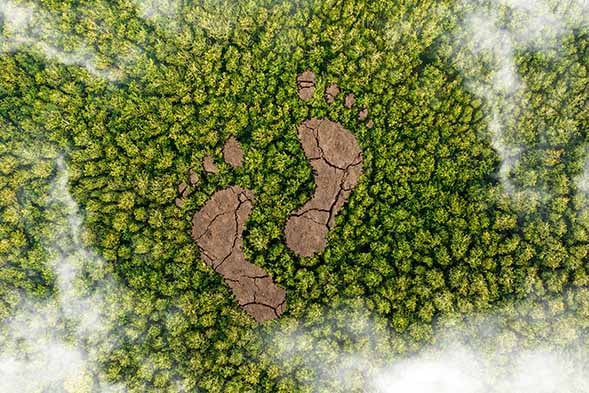
Most organisations believe they understand their environmental footprint. Carbon emissions are calculated, KPIs are tracked, and environmental disclosures are included in annual or sustainability reports. However, when methodologies and boundaries are examined closely, material gaps often emerge. Underestimation is rarely intentional. It is usually structural.
Research, from CDP and a Boston Consulting Group, of shows that most organisations are only capturing a fraction of their environmental footprint. Studies suggest that 75–90% of a company’s emissions often sit within its value chain, yet only around 38% of businesses currently track these Scope 3 emissions. In some sectors, supply-chain emissions can be up to 26 times higher than direct operational emissions, highlighting how easily environmental impact can be underestimated when measurement boundaries remain narrow.
This article explores why many organisations underestimate their environmental footprint, examining the structural blind spots, data limitations, and value chain complexities that often result in incomplete environmental measurement.
Where footprints are commonly understated
On 12 March 2025, Minister of Finance Enoch Godongwana delivered his 2025 Budget speech under the Government of National Unity following 2024 national election that did not result in a party with outright majority. The budget was delivered amid rising cost of living and high level of youth joblessness. We provide herewith the analysis and the commentary of some of the major budgetary items:
Why this is common
These challenges are widespread. Sustainability reporting expectations have matured rapidly, particularly as assurance and regulatory scrutiny increase. Many organisations built early reporting systems under different disclosure requirements, and what was sufficient five years ago may not meet current governance standards. Furthermore, environmental data often sits outside finance, while reporting expectations increasingly mirror financial governance. This structural gap contributes to inconsistency. Underestimation is therefore more a function of system maturity than capability.
What stronger environmental governance looks like
Building a credible environmental footprint does not require perfect data. What it requires is clarity, consistency, and strong governance. Organisations with mature environmental management recognise that uncertainty is inevitable, particularly when measuring complex value chains and evolving methodologies. Rather than aiming for perfect precision, they focus on establishing clear boundaries, applying consistent methods, documenting assumptions, and ensuring transparency in how environmental data is produced and reported.
Organisations with mature environmental governance typically demonstrate:
- Clearly defined and documented reporting boundaries
- Consistent application of methodologies over time
- Transparent documentation of assumptions and estimates
- Structured screening of value chain impacts
- Integration between sustainability, finance, and risk functions
- Oversight mechanisms that monitor methodological changes
- Clear policies for uncertainty disclosure and restating baselines when methodologies improve
The objective is not to eliminate uncertainty. It is to manage it transparently and consistently.
Governance implications
As sustainability information increasingly falls within the scope of assurance and board oversight, methodological robustness becomes as important as reported performance. Environmental disclosures are now expected to meet higher standards of governance, transparency, and consistency. Where environmental footprints are understated or calculated on incomplete baselines, organisations may face a range of risks that extend beyond reporting itself.
Underestimated footprints can lead to:
- Revisions under assurance review
- Misaligned targets based on incomplete baselines
- Reputational exposure
- Strategic decisions based on incomplete data
- Distorted capital allocation and transition planning decisions
Environmental reporting is no longer a communications exercise. It is a governance issue.
Questions boards should be asking
As environmental disclosures move closer to the level of financial reporting, boards must ask critical questions to ensure that the organisation’s environmental footprint is credible, consistent, and governance-ready.
Below are some of the questions boards should be asking themselves:
- Are our reporting boundaries clearly defined and consistently applied across reporting periods?
- Have we screened all material value chain impacts?
- Can we explain year on year performance changes operationally?
- Would our footprint withstand detailed assurance scrutiny?
Conclusion
Most organisations do not deliberately understate their environmental impact. They inherit fragmented systems, evolving methodologies, and expanding disclosure expectations. As sustainability governance matures, organisations that strengthen boundary clarity, data integration, and methodological consistency will be better positioned to deliver credible performance and withstand scrutiny.
Understanding the full environmental footprint is not about perfection.
It is about defensible governance.
At SNG Grant Thornton, we support organisations in strengthening environmental reporting frameworks, improving methodological integrity, and aligning sustainability information with evolving assurance and governance expectations.

Environmental footprint

Omar Hassan

Oupa Mbokodo